Planning a successful event in Atlanta requires much more than a strong lineup, a well-designed venue, or an effective marketing campaign. When people gather in large numbers, organizers also have to think about entrances, exits, parking, pedestrian movement, restricted areas, staff safety, emergency access, crowd behavior, and the possibility that a small problem could quickly become a much larger disruption. Professional event security and crowd control help organizers manage those risks before they become incidents.
Whether the event is a neighborhood festival, corporate gathering, concert, fundraiser, sporting-related celebration, private function, or multi-day public event, the security plan should be built around the actual environment. A small indoor gathering may require a very different approach from a large outdoor festival with multiple entrances, vendors, alcohol service, stages, parking areas, and thousands of guests. The right event security team evaluates those differences and builds coverage accordingly.
For Atlanta organizers, working with trained off-duty police officers can add a highly visible layer of authority and public-safety experience. Armor Consulting provides POST-certified officers for event security, crowd control, traffic support, and event security coordination services in Atlanta. The goal is not simply to place officers at a venue. It is to create an organized security presence that supports guests, staff, vendors, venue management, and event leadership from setup through closing.
Why Event Security Should Be Planned Before Guests Arrive
The strongest event security plans begin before the first guest enters the property. Waiting until an incident happens makes security reactive. Pre-event planning allows organizers and security professionals to identify predictable pressure points, determine where officers should be positioned, establish communication procedures, and decide how different teams will respond if conditions change.
A pre-event assessment should consider the venue layout, expected attendance, event schedule, entrances and exits, parking arrangements, pedestrian routes, stage or performance areas, VIP locations, vendor areas, alcohol service, restricted spaces, emergency access, and nearby public roads. The plan should also consider how the crowd is likely to move at different times. Guest arrival, peak attendance, intermission, headline performance, and departure can all create different security challenges.
Professional planning also helps avoid unnecessary staffing. Instead of placing officers everywhere without a clear purpose, a security coordinator can identify the locations where visibility and response capability matter most. That creates a more efficient deployment while maintaining coverage where it is needed.
Understanding Crowd Control at Events
Crowd control is not simply telling people where to stand. It is the organized management of people moving through a shared environment. The objective is to maintain safe movement, prevent dangerous congestion, protect access points, and recognize changes in crowd behavior early.
At concerts and festivals, crowd movement can change rapidly. Guests may gather around a stage, line up at an entrance, move toward a food or merchandise area, or leave at the same time after a performance. If pedestrian routes intersect with vehicle traffic, the risk becomes more complex. Security personnel must understand these patterns and remain alert to developing congestion.
Good crowd control is also about communication. Officers should be approachable enough for guests to ask questions and visible enough that their presence is understood. Clear directions can prevent frustration, reduce confusion, and help people move through an event safely without creating unnecessary confrontation.
- Monitoring entrances, exits, and high-traffic areas.
- Supporting orderly lines and controlled guest movement.
- Watching for crowd congestion and emerging safety concerns.
- Protecting restricted areas and staff-only spaces.
- Maintaining clear emergency access routes.
- Supporting venue and event staff when a situation requires additional authority.
- Communicating observations quickly to event leadership and other security personnel.
Where Event Security Officers Add the Most Value
Officer placement should follow the event risk assessment rather than a generic formula. Some locations deserve consistent visibility because they naturally attract activity or create opportunities for problems. Entrances and exits are common examples because they concentrate people and provide access to the event. VIP areas may require additional protection because of the people present and the need to keep unauthorized guests away.
Backstage areas, loading zones, equipment areas, cash-handling locations, and restricted staff spaces can also require coverage. At outdoor events, perimeter areas and transitions between parking lots and the venue may be important. If alcohol is being served, organizers may need additional attention around guest behavior, entry screening, and areas where crowds remain for long periods.
The objective is not to make an event feel heavily policed. A professional security presence should support a welcoming environment while providing the capability to respond when necessary. Uniformed officers can provide a visible deterrent while still interacting professionally with guests.
Event Security for Concerts
Concert security can involve unique crowd dynamics because guests are often focused on a performance rather than their surroundings. During a popular act, people may move toward the stage, form dense groups, or react quickly to changes in the performance. Security teams must monitor the audience while also protecting performers, backstage areas, production staff, and emergency routes.
A concert security plan should consider entrances, ticketing areas, barricades, stage-adjacent spaces, backstage access, artist routes, staff entrances, emergency exits, parking, rideshare areas, and post-event departure. Officers can also coordinate with venue personnel so that everyone understands who is responsible for each area.
For large concerts, security and traffic control should often be planned together. Guests may arrive within a narrow period, and a poorly managed parking or rideshare area can create congestion outside the venue. Dedicated traffic control officers can help separate vehicle and pedestrian movement while event security personnel focus on the interior environment.
Event Security for Festivals and Outdoor Gatherings
Outdoor festivals can spread activity across a large footprint. Multiple stages, vendors, food areas, restrooms, parking lots, entrances, sponsor installations, family areas, and temporary structures create a more complicated security environment than a single-room event.
A festival security plan should account for the entire site, not just the main stage. Officers may be needed at entrances, high-traffic intersections, restricted areas, vendor zones, parking transitions, and locations where the public can move between different parts of the property.
Weather, temporary structures, changing attendance, and schedule changes can also affect crowd movement. The security team should be prepared to adjust officer positions as the event develops. Flexible deployment can be especially valuable during peak arrival and departure periods.
The Role of Off-Duty Police Officers in Event Security
Off-duty police officers can bring a different level of experience and authority to an event security assignment. Because they are trained law enforcement professionals, their responsibilities can extend beyond the limited role of observing and reporting. Their presence can provide organizers with trained personnel who understand public safety, de-escalation, incident response, and law-enforcement procedures.
This does not mean every event requires police officers. The appropriate staffing model depends on the event, venue, attendance, risk factors, and organizer requirements. The important point is that security should be matched to the actual needs of the event rather than selected only by price or a fixed headcount.
Armor Consulting’s officers are POST-certified and provide off-duty police security for events in Atlanta. For events that need broader planning, the company can coordinate security, traffic, access points, and other operational requirements.
How Security and Traffic Control Work Together
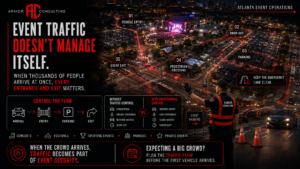
Event security and traffic control are closely connected, but they are not exactly the same function. Security focuses on people, property, access, crowd behavior, and response to safety concerns. Traffic control focuses on vehicle movement, pedestrian crossings, parking flow, road access, and areas where vehicles and people interact.
Combining the two services can make sense for larger events. For example, security officers may monitor an entrance while traffic control officers manage the road immediately outside the entrance. Another officer may protect a restricted area while traffic personnel direct vehicles toward an overflow parking lot. When the teams understand the overall event plan, they can communicate and reduce gaps.
Armor Consulting provides traffic control officer services in Atlanta for events and can coordinate traffic support with event security when required. This integrated approach can be particularly useful when guest arrival and departure create high-volume vehicle movement.
How Many Event Security Officers Do You Need?
There is no universal officer-to-guest formula that can accurately determine staffing for every event. A 1,000-person indoor corporate event may have a very different security profile from a 1,000-person outdoor concert. The venue layout, event type, guest profile, alcohol service, number of entrances, VIP presence, parking arrangements, operating hours, and history of the location can all affect staffing needs.
A better approach is to conduct a site and event assessment. Start with expected attendance and then examine where people will gather, how they will enter and leave, and which areas require controlled access. From there, security leadership can recommend officer positions and coverage periods.
Staffing should also account for the event timeline. You may not need the same number of officers during setup as you do during peak attendance. Some events require stronger coverage during guest arrival and departure, while others need consistent coverage throughout the program.
What a Professional Event Security Plan Should Include
A useful event security plan should be practical enough for officers and event staff to follow. It should identify the site, key access points, restricted areas, officer positions, communication procedures, escalation expectations, emergency access routes, and coordination responsibilities.
- Event date, hours, setup period, and expected attendance.
- Venue map and major access points.
- Entrance and exit locations.
- Parking and pedestrian routes.
- VIP and restricted areas.
- Stage, backstage, and production areas.
- Vendor and staff-only zones.
- Emergency vehicle access routes.
- Communication contacts and escalation procedures.
- Officer deployment and shift coverage.
- Traffic control requirements.
- Contingency planning for changing conditions.
Choosing an Event Security Company in Atlanta
When evaluating an event security company, organizers should look beyond the number of officers available. Ask about training, certification, experience, communication, scheduling, planning, and the company’s ability to coordinate with venue and event staff.
It is also important to understand whether the provider can scale services. An organizer may need basic security for a private gathering one month and a much larger team for a festival later in the year. A provider with multiple security capabilities can make that process easier.
Armor Consulting has more than 20 years of experience serving metro Atlanta, and its Armor Consulting services include POST-certified officers for event security, traffic control, neighborhood patrols, and executive protection. The company works with organizers to assess the event and determine appropriate coverage.
Common Event Security Mistakes to Avoid
- Waiting until the final days to think about security.
- Using the same staffing plan for every type of event.
- Ignoring parking and pedestrian movement.
- Focusing only on the main entrance while overlooking exits and restricted areas.
- Failing to define who makes security decisions during an incident.
- Not planning for peak arrival and departure periods.
- Treating traffic control and event security as completely separate operations.
- Choosing staffing solely on the lowest price without evaluating training and experience.
- Failing to walk the site with the security provider before the event.
Final Checklist for Atlanta Event Organizers
Before finalizing event security, confirm the expected attendance, venue layout, entrances and exits, parking plan, restricted areas, VIP requirements, alcohol service, event schedule, traffic patterns, emergency access, and security contacts. Then review the plan with the security provider and make sure every major responsibility has an owner.
Booking Timelines and What Affects Event Security Cost
Event security pricing is rarely a single hourly figure applied across every job. Officer type, number of positions, total hours, event risk profile, venue requirements, and whether traffic control is included all affect what a plan costs. An event with one controlled entrance and 200 guests sits in a different range from a multi-stage festival with several access points, alcohol service, and overnight equipment on site.
Timing matters as much as scope. Officer availability in metro Atlanta tightens around major weekends, holidays, graduation season, and dates when several large events compete for the same personnel. Requests submitted a few days out limit the options and can force a smaller team than the event warrants.
For most events, reaching out three to four weeks ahead gives enough time for a site walk, a written plan, and confirmed staffing. Larger festivals, multi-day events, and anything requiring road access coordination should start earlier. When you request a quote, having the date, venue, expected attendance, hours, parking arrangements, and alcohol plans ready will produce a far more accurate estimate than an attendance number alone.
Frequently Asked Questions
What is the difference between event security and crowd control?
Event security covers the broader protection of people, property, and access at a venue, including entrances, restricted areas, staff support, and incident response. Crowd control is one part of that work, focused specifically on how guests move through the space, where congestion forms, and how to keep pedestrian flow safe during arrival, peak attendance, and departure.
How many security officers does an event need?
There is no reliable officer-to-guest ratio that works across every event. Staffing should follow a site assessment that accounts for venue layout, number of entrances, expected attendance, alcohol service, VIP areas, parking, event hours, and the history of the location. Two events with identical guest counts can require very different coverage.
Do off-duty police officers provide better event security than unarmed guards?
They provide a different capability rather than a universally better one. Off-duty officers bring law-enforcement training, arrest authority, and public-safety experience, which matters at events with higher risk, alcohol service, or significant public exposure. Smaller private functions may be served well by a smaller uniformed presence. The right answer depends on the event.
How far in advance should event security be booked?
Three to four weeks is a reasonable target for most events, and longer for festivals, multi-day programs, or anything requiring coordination around public roads. Earlier booking gives time for a site walk and a written plan, and it protects against officer availability tightening around busy weekends.
Does event security include traffic control?
Not automatically. The two functions overlap but are staffed and planned separately. Many Atlanta events benefit from combining them, so that officers managing the entrance and officers managing the road outside it are working from the same plan and communicating directly.
What should organizers prepare before the security walkthrough?
Bring the venue map, event schedule, expected attendance, entrance and exit plan, parking arrangements, vendor and VIP locations, alcohol service details, and the name of the person authorized to make security decisions on event day. That last item is the one most often left undecided until it is needed.
Conclusion
A strong security plan should make the event safer without unnecessarily disrupting the guest experience. Professional officers should be visible, approachable, prepared, and positioned where they can make a difference. When security, crowd control, traffic management, and event operations are coordinated, organizers can focus more confidently on delivering a successful event.
The events that run smoothly are rarely the ones with the most officers on site. They are the ones where the plan was built around the actual venue, the coverage followed the risk, and every responsibility had a clear owner before the gates opened.
If you are planning a festival, concert, corporate function, private gathering, or other event in Atlanta, Armor Consulting can help evaluate your security requirements and build a coverage plan around your event. Request a quote to discuss your date, venue, expected attendance, and security needs.